

Heres a question for all you motor/electrical guys. Let me see if Im on track. . . if I run a 10 watt anchor light for 8 hours, (12volt) Ive used 6.6 hours of battery life, right? (10 watts divided by 12 volts = .83 times 8 hours = 6.6 hours)
If this is true and I have a Merc 60. . . heres the question:
How long do I have to run the motor to charge for the loss?
Will RPM make a difference or is it just the time running?
Basically Im looking for the output of the alternator, anyone know?
Thanks,
Harrison
Merc 60 alternator output
-
Frank C
-
End Of Message
- Posts: 4
- Joined: Tue Apr 11, 2006 6:12 am
10W/12V=.83A x 8 hours = 6.6 amp-hours.
The BigFoot 60 is rated at a maximum output of 18A on the web page and 20A in the Service manual. It cannot output that much at idle and probably doesn't have that maximum capacity until around 1500-2000 rpm.
Even at that, how much it actually outputs depends upon the number and capacity of the batteries, and their states of charge, i.e. the demand on it. Plus, the acceptance rate of the battery(ies) isn't linear, but decreases rapidly above about 80% charge, where it may even take longer to get to 100% than it did to get from 80% to 20%. So you can't assume the maximum charge capability is the actual charge.
And the answer isn't as simple as it appears.
The BigFoot 60 is rated at a maximum output of 18A on the web page and 20A in the Service manual. It cannot output that much at idle and probably doesn't have that maximum capacity until around 1500-2000 rpm.
Even at that, how much it actually outputs depends upon the number and capacity of the batteries, and their states of charge, i.e. the demand on it. Plus, the acceptance rate of the battery(ies) isn't linear, but decreases rapidly above about 80% charge, where it may even take longer to get to 100% than it did to get from 80% to 20%. So you can't assume the maximum charge capability is the actual charge.
And the answer isn't as simple as it appears.
-
Chip Hindes

- Admiral
- Posts: 2166
- Joined: Mon Jan 05, 2004 6:13 am
- Location: West Sand Lake, NY '01X, "Nextboat" 50HP Tohatsu
You're a little confused on the usage calculation.
The way you did the calculation, 10 watts divided by 12v is .83 amps, times 8 hours is 6.7 amp hours. Then divide by your alternator output in amps (my Tohatsu 50D mine is 11 amps) = .61 hours, about 37 minutes.
Slightly easier, You could also take 10 Watts for 8 hours = 80 watt hours. Divide by the alternator output in watts (mine is 130) and wonder of wonders, get the same answer, .61 hours. Point is, if you have the alternator output in watts, you can completely skip the division by 12 process of converting watts to amps.
You can also take the alternator output if rated in amps, and multiply by 12 to get watts.
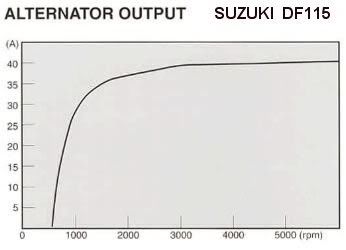
Note that by the graph Frank presented, at anything much off idle the DF115 alternator is putting out close to max power. It would be nice if all alternators behaved in this fashion, but I have no idea if it's so. Also, I believe the DF115 like most EFI motors is rated at 40 amps gross, not net. The electronic fuel injection and pumps suck down a fair portion of this, so not all is available for charging the battery. Conversely the carbureted models have no fuel pump and magneto ignition, so the power used to run the motor is pretty close to zero.
Even so, I'm sure the 40 amp Suzuki system provides a whole lot more battery charging than my puny Tohatsu.
The way you did the calculation, 10 watts divided by 12v is .83 amps, times 8 hours is 6.7 amp hours. Then divide by your alternator output in amps (my Tohatsu 50D mine is 11 amps) = .61 hours, about 37 minutes.
Slightly easier, You could also take 10 Watts for 8 hours = 80 watt hours. Divide by the alternator output in watts (mine is 130) and wonder of wonders, get the same answer, .61 hours. Point is, if you have the alternator output in watts, you can completely skip the division by 12 process of converting watts to amps.
You can also take the alternator output if rated in amps, and multiply by 12 to get watts.
Note that by the graph Frank presented, at anything much off idle the DF115 alternator is putting out close to max power. It would be nice if all alternators behaved in this fashion, but I have no idea if it's so. Also, I believe the DF115 like most EFI motors is rated at 40 amps gross, not net. The electronic fuel injection and pumps suck down a fair portion of this, so not all is available for charging the battery. Conversely the carbureted models have no fuel pump and magneto ignition, so the power used to run the motor is pretty close to zero.
Even so, I'm sure the 40 amp Suzuki system provides a whole lot more battery charging than my puny Tohatsu.
-
FreeStyle

- Deckhand
- Posts: 31
- Joined: Sat May 27, 2006 11:42 am
- Sailboat: MacGregor 26M
- Location: Atlanta '06 26M 60HP Yamaha
There are a number of variables that make this calculation problematic. The graph posted by Frank is undoubtedly produced with a constant resistive load on the system and, as End of Message points out, the battery would not present a constant load over its range of charged conditions.
As Chip points out, other loads would also place demands on the available charging current capacity of the motor including nav gear, hot tub, etc.
Batteries heat up when being charged; this is energy from the charging source that will not be used to charge the battery.
The calculations for energy usage assume the battery voltage remains constant while discharging. I think you will find the voltage will decrease by some amount.
The bottom line in my opinion is that the method Chip gave for calculating the charging time is essentially correct but I would add a 30-50% safety margin to it to account for the various inefficiencies and unknowns.
As Chip points out, other loads would also place demands on the available charging current capacity of the motor including nav gear, hot tub, etc.
Batteries heat up when being charged; this is energy from the charging source that will not be used to charge the battery.
The calculations for energy usage assume the battery voltage remains constant while discharging. I think you will find the voltage will decrease by some amount.
The bottom line in my opinion is that the method Chip gave for calculating the charging time is essentially correct but I would add a 30-50% safety margin to it to account for the various inefficiencies and unknowns.
-
Catigale

- Site Admin
- Posts: 10421
- Joined: Fri Jun 11, 2004 5:59 pm
- Sailboat: MacGregor 26X
- Location: Admiral .............Catigale 2002X.......Lots of Harpoon Hobie 16 Skiffs....Island 17
- Contact:
Merc 50 and 60 engines are the same except for software IIRC...and the alternator reaches the 200W rated capacity at 2000 rpm.
Ive promised Chip I would measure the amp load on the engine but havent got a RoundTuit yet...lets guesstimate 50 Watts of the 200.
One group 42 battery is good for 960 Watts hours total, so that 10 watt anchor isnt using much capacity (<10%) of your system
Ive promised Chip I would measure the amp load on the engine but havent got a RoundTuit yet...lets guesstimate 50 Watts of the 200.
One group 42 battery is good for 960 Watts hours total, so that 10 watt anchor isnt using much capacity (<10%) of your system
-
Night Sailor

- Admiral
- Posts: 1007
- Joined: Mon Dec 26, 2005 4:56 pm
- Sailboat: MacGregor 26X
- Location: '98, MACX1780I798, '97 Merc 50hp Classic, Denton Co. TX "Duet"
Capacity over rated
Let's not forget that experts tell us we should never figure our energy budget capacity based on the fully charged ratings for a brand new battery. For efficiency and long life, the batteries should not be discharged to more than 50% of their rated capacity. So, in Catigale's example, a battery with 980 watts (80 ah) rating, you would only want to plan on using a maximum of 490 watts (40 ah) before doing a thorough and complete recharge. Add heat, age, incomplete recharging, or phantom drains and you have even less to work with, you might consider a 10% margin for environmental conditions.
-
Harrison

- First Officer
- Posts: 307
- Joined: Tue Jan 04, 2005 12:57 pm
- Location: Frederick, CO. '05 M, Merc 60 Bigfoot
Great info guys. Thanks. Lot of information. I am aware that there many variables and factors that need to be taken into consideration. What Im looking for is a quick, simple, sailors rule of thumb so to speak, to get me in the ballpark. It looks like with all your help, Ive found it.
What Ill do is use watts used, divided by 150, to give me an approximate engine run time in hours. Of course Ill pad it accordingly, and check with my volt meter. But like I said, Im just looking for a starting point to put me in the ballpark.
Thanks again,
Harrison
What Ill do is use watts used, divided by 150, to give me an approximate engine run time in hours. Of course Ill pad it accordingly, and check with my volt meter. But like I said, Im just looking for a starting point to put me in the ballpark.
Thanks again,
Harrison
-
mtc

- Captain
- Posts: 545
- Joined: Mon Feb 21, 2005 5:06 pm
- Sailboat: MacGregor 26M
- Location: Panama City Beach, Florida 05 M 'Bellaroo' 60hp Merc BF
Lots of mathematical testosterone. Reminds me of my years of Calc. We could take the integral over time . . .
Or, install a voltmeter, run the light, read the meter, run the motor, read the meter, mark the time. That will give you a ball-park time requirement for future charging needs if you also take into account battery condition, wiring, temp, specific gravity and solutions levels in batts cells, etc.
I'd wager that each time you did this, you'll get different times; particularly when working with the formulas.
Hmmm. . . what will be the interior temp of the cabin reach at 2PM with the boat sitting in brackish water as the sun subtends a 120 degree angle on the surface with ambient air over deck 92.1 F at 89% humidity given there is 1.1 square feet of unassisted ventilation space with a steady 5.6 KT breeze. . .
Hot, really hot.
Michael
Or, install a voltmeter, run the light, read the meter, run the motor, read the meter, mark the time. That will give you a ball-park time requirement for future charging needs if you also take into account battery condition, wiring, temp, specific gravity and solutions levels in batts cells, etc.
I'd wager that each time you did this, you'll get different times; particularly when working with the formulas.
Hmmm. . . what will be the interior temp of the cabin reach at 2PM with the boat sitting in brackish water as the sun subtends a 120 degree angle on the surface with ambient air over deck 92.1 F at 89% humidity given there is 1.1 square feet of unassisted ventilation space with a steady 5.6 KT breeze. . .
Hot, really hot.
Michael
-
Frank C
mtc wrote:Hot, really hot.
Michael

Never did "get it" after Algebra, Trig and Geometry. Even so, logs, sine and cosine left me a bit befuddled. Bought a Cliff's Notes for pre-Calculus recently (at age 58 ) cause I KNOW it wasn't really that hard. I just had other priorities!
Haven't yet opened Cliff, but also bought a cheapo Casio calculator with "natural display" ability.
Also keep looking at that TI graphing model in Costco (83+?). They're so cheap now!!
-
mtc
- Captain
- Posts: 545
- Joined: Mon Feb 21, 2005 5:06 pm
- Sailboat: MacGregor 26M
- Location: Panama City Beach, Florida 05 M 'Bellaroo' 60hp Merc BF
Me neither, Frank.Frank C wrote:
Never did "get it" after Algebra, Trig and Geometry.
My undergrad was Chem/Math duel - now when do you think i'm using all that really, really cool stuff? Can't tell you the last time I took the integral of the bolt hole volume to determine the accurate amount of 5200 to apply at the correct dew point.
I just considered it as exercise for the brain. Actually feel sharper now at 54 then when I was batteling Calc! Like you said, we had different priorities then.
Why, oh why, are you punishing yourself with Cliff notes? Let's start a Mac Dif E study group? I'm in.
In this case, the function u is given by

= hot, really hot.
Michael